
 English
 русский
 Español
 عربى
عربى

No 1255, Xingye Road, Tianzihu Modern Industrial Park, Anji County, Zhejiang Province, China
Content
A swivel dining chair and a traditional dining chair solve the same basic need in very different ways. One turns with the room, the other holds its ground. Understanding the mechanism, the materials, and the setting each was built for makes the choice between them a lot easier.
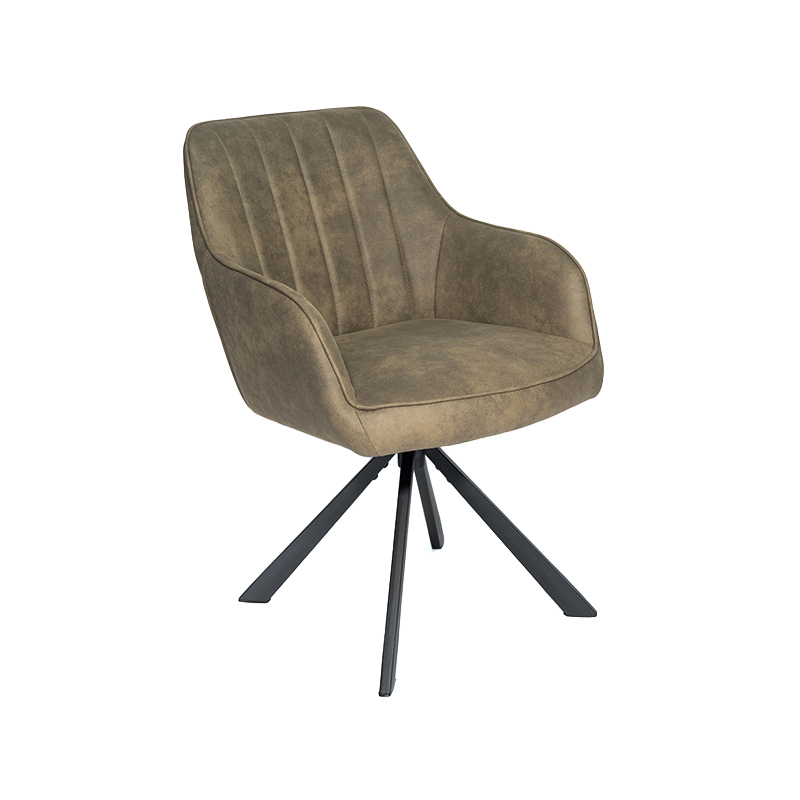
A swivel dining chair is a dining seat built around a rotating mechanism that lets the chair turn smoothly, typically through a full 360 degrees, while keeping the seat comfortable and structurally stable. The construction combines an upholstered seat, a swivel base mechanism, a supporting frame, and a cushioned backrest into a single unit designed for both movement and support.
Common materials include suede fabric, leather, polyester upholstery, metal frames, and wooden structural elements, giving buyers a wide range of finishes to match different interiors. The defining traits of a swivel dining chair are flexible movement, enhanced seating comfort, a modern silhouette, and the ability to serve more than one function in a room.
A traditional dining chair is a fixed-position seat designed primarily for dining, built without any rotating hardware. Its value lies in simplicity: a stable seating position, a classic profile, and a structure that requires very little upkeep over the years.
Traditional dining chairs commonly appear as wooden chairs, fabric-upholstered chairs, fully upholstered chairs, and metal-frame chairs, and they show up everywhere from home dining rooms to restaurants, hotels, and cafes where consistent, no-frills seating is the priority.
| Factor | Swivel Dining Chair | Traditional Dining Chair |
| Movement | 360 degree rotation | Fixed position |
| Flexibility | Higher mobility | Limited movement |
| Comfort | Easier body movement | Standard sitting experience |
| Design style | Modern and functional | Classic and simple |
| Space usage | Suited to flexible layouts | Requires fixed positioning |
| Maintenance | More mechanism components | Simpler structure |
| Applications | Homes, restaurants, hotels, offices | Mainly dining spaces |
The right choice depends on whether a project prioritizes flexibility and comfort, or the simplicity and cost predictability of a fixed-position design.
Three components determine how well a swivel dining chair performs over years of daily use. The rotation base provides smooth movement and supports the turning function itself. The bearing system needs to deliver quiet operation, smooth rotation, and long-term durability without excess play. Structural stability, covering weight capacity and frame strength, determines whether the chair holds up to repeated use without loosening.
A high-quality swivel mechanism does more than let a chair turn — it determines how long that chair stays quiet, stable, and comfortable after years of daily use.
Swivel suits modern apartments and open-plan homes, offering flexible movement and a premium look.
Traditional suits classic dining rooms and formal settings, valued for timeless design.
Swivel improves guest comfort and builds a more premium dining experience.
Traditional offers easy maintenance and efficient, high-volume seating arrangement.
Swivel fits luxury dining areas and lounge spaces well.
Traditional remains practical for large-scale furniture projects.
An elegant texture and high-end visual effect that elevates the whole room.
A soft surface that creates a warm, inviting seating experience.
Works well in modern interiors, luxury restaurants, and hospitality projects alike.
Dining chair design is moving toward multifunctional furniture that blends swivel functions with flexible, space-conscious designs. Ergonomic construction is placing more emphasis on posture support and everyday comfort, while sustainable materials, including eco-friendly and recyclable fabrics, are becoming a standard expectation rather than a premium add-on. At the same time, demand for customized furniture solutions, from personalized colors to project-based dimensions, continues to grow across both residential and hospitality markets.
A swivel dining chair rotates on a base mechanism, while a regular dining chair stays fixed in one position with a simpler structure.
Yes. The rotating base allows natural movement and easier interaction, which many users find more comfortable during longer meals or gatherings.
Yes, particularly in premium or lounge-style dining settings where guest comfort and a modern atmosphere are priorities.
Common materials include suede fabric, leather, polyester upholstery, metal frames, and wooden structural components.
Durability depends on the quality of the bearing system and frame construction, but a well-built mechanism is designed for smooth, quiet operation over years of daily use.
Swivel dining chairs generally work better in compact or multifunctional spaces since they allow flexible movement without needing extra room to reposition the chair.

Products
Contact info.
No 1255, Xingye Road, Tianzihu Modern Industrial Park, Anji County, Zhejiang Province, China
+86-13587919519
sales@bftfurniture.com
