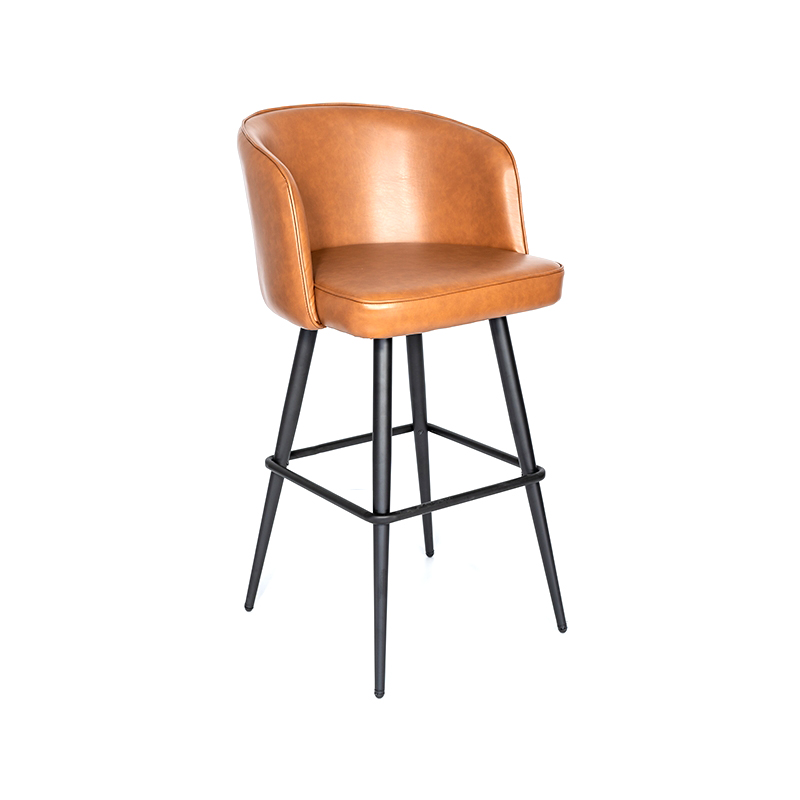
A brown leather fixed height bar stool with backrest is one of the few seating decisions that resolves three problems at once: it anchors a kitchen island with a material that improves with age, provides the lumbar support that backless stools omit, and eliminates the mechanical unreliability of height-adjustment cylinders that fail under daily use. It is a specification, not a style choice.
15–25 yr
Service life of full-grain leather upholstery with basic conditioning maintenance
73–78 cm
Correct fixed seat height for standard 90–105 cm kitchen island or bar counters
200 kg
Static load rating of quality fixed-leg bar stool frames — no pneumatic cylinder limit
Brown Leather Bar Stool Comfort: Surface, Padding, and Posture
Brown leather bar stool comfort is determined by three layered variables: the leather surface behavior, the seat foam specification, and the backrest geometry. Each operates independently — a correctly padded seat under poor-quality leather still produces discomfort, and premium leather over insufficient foam bottoms out within months. All three must be specified together.
01
Leather Surface Behavior
Full-grain leather breathes through its natural pore structure, preventing heat accumulation at the seat contact surface. Split leather and bonded leather have closed, treated surfaces that trap heat identically to vinyl — the primary comfort complaint in warm kitchen environments. Specify full-grain or top-grain leather for any stool used in proximity to cooking heat.
02
Seat Foam Density
Bar stool seat foam rated below 40 kg/m3 compresses permanently within 12–18 months, leaving a leather shell over a flat board. High-resilience foam at 45–55 kg/m3 returns to original thickness after each use and maintains consistent cushioning over a 10+ year service life. Seat depth should be 38–42 cm to support the full thigh without edge pressure.
03
Backrest Geometry
A backrest positioned 15–18 cm above the seat surface contacts the lumbar spine rather than the mid-back — the correct support point for counter-height seating where the torso is pitched slightly forward. Backrests above 22 cm push the user forward off the seat rather than supporting them against it.
04
A fixed footrest rail at 20–25 cm above the floor reduces leg fatigue at bar height by offloading the weight of the lower leg from the knee joint. Without footrest support, dangling legs create hamstring compression against the seat edge within 20–30 minutes — the primary discomfort mechanism in poorly specified bar seating.
Fixed Height Bar Stool Durability: Why No Moving Parts Outlast Every Mechanism
Fixed height bar stool durability has a structural logic that adjustable alternatives cannot match: a frame with no moving components has no mechanism to fail. Pneumatic gas cylinders — the height-adjustment mechanism in adjustable bar stools — are rated for 50,000–80,000 actuation cycles by most manufacturers. In a household with two to four stools used daily, this represents a 10–15 year lifespan for the cylinder itself. In commercial environments with continuous use, cylinders fail within 3–5 years. Fixed-leg stools have no equivalent failure mode.
MATERIAL HIERARCHY
Full-grain leather retains the complete grain surface of the hide — the most durable layer, which develops a patina over decades. Top-grain leather has the surface sanded and refinished — durable, more uniform. Split leather is the underside of the hide — weak, prone to peeling. Bonded leather is leather fiber scraps bonded with polyurethane — fails within 2–3 years under regular use.
| Frame Material |
Load Rating |
Corrosion Resistance |
Service Life |
Best Use |
| Solid beech hardwood |
150–180 kg |
Low — sensitive to humidity |
10–20 yr with maintenance |
Dry residential interiors |
| Powder-coated steel |
180–220 kg |
Medium — coating protects |
15–25 yr |
Kitchen and bar environments |
| Stainless steel |
200–250 kg |
Very high |
25+ yr |
High-humidity or commercial |
| Cast iron base |
250+ kg |
Medium — requires coating |
20+ yr |
Heavy-duty or industrial aesthetic |
Bar Stool with Backrest Support: The Ergonomic Case for the Back Panel
Bar stool with backrest support addresses the postural reality of counter-height seating that backless designs ignore. At 73–78 cm seat height, the human torso sits above its natural center of gravity support zone — the lower back musculature works continuously to maintain upright posture without a backrest reference point. After 20–30 minutes, fatigue in the erector spinae muscles produces the characteristic forward slump that makes backless stools unsuitable for any seated activity beyond brief perching.
Backless Bar Stool — Postural Reality
- No lumbar reference — erector spinae fatigue in 20–30 min
- Forward slump develops — increases disc compression at L4-L5
- Core engagement required continuously — fatiguing for casual use
- No support for reclined or relaxed posture during meals
- Users lean on counter edge — transfers load to wrist and forearm
With Backrest — Postural Benefit
- Lumbar contact point reduces erector spinae load by up to 40%
- Neutral spine maintained passively — no active muscle engagement
- Reclined posture supported during meals and conversation
- Weight distribution across seat and backrest reduces seat pressure
- Usable for 60+ minute sessions without discomfort onset
Brown Leather Bar Stool for Kitchen Islands: Sizing and Spacing
Brown leather bar stool for kitchen islands requires exact dimensional matching between counter height, stool seat height, and inter-stool spacing to function correctly. Counter height varies between 90 cm (standard kitchen bench) and 105 cm (bar-height island) — a 15 cm range that requires different fixed seat heights and cannot be bridged by a single stool specification without adjustability.
Counter Height Seat Height Knee Clearance Stool Spacing
90 cm (bench) 60–65 cm 25–30 cm 55–60 cm center
96 cm (standard island) 65–70 cm 26–31 cm 55–60 cm center
105 cm (bar height) 73–78 cm 27–32 cm 60–65 cm center
Inter-stool spacing of 55–65 cm center-to-center allows seated users to face forward without shoulder contact. Narrower spacing forces users to angle their bodies — the primary cause of discomfort at crowded kitchen islands and the reason professional kitchen designers specify stool count from island length divided by 60 cm, not by visual proportion.
Brown Leather Bar Stool Design: Material Aging and Interior Integration
Brown leather bar stool design occupies a unique position in interior specification: it is one of very few seating materials that improves in appearance over time rather than degrading. Full-grain brown leather develops a patina — a surface darkening and softening at contact points — that signals quality and age in a way no synthetic material replicates. A five-year-old full-grain leather stool in a well-maintained kitchen reads as intentional and premium. A five-year-old bonded leather or vinyl stool reads as worn and due for replacement.
Fixed Height Bar Stool vs Adjustable Bar Stool: A Definitive Comparison
The fixed height bar stool vs adjustable bar stool decision has one overriding variable: counter height consistency. If every seating position in the space is at the same counter height — as is standard in kitchen island design — fixed height is the correct specification. Adjustability adds mechanical complexity, cost, and a failure mode without adding functional value when the counter height is uniform.
Fixed Height
- No mechanical components — no failure modes
- Higher static load rating — no cylinder capacity limit
- Lower long-term cost — no cylinder replacement
- Cleaner aesthetic — no visible mechanism under seat
- Correct for single counter height — most residential kitchens
- Leather upholstery sits flush — no gap from seat ring
Adjustable Height
- Cylinder rated 50,000–80,000 cycles before failure
- Load capacity limited by cylinder spec — typically 120–150 kg
- Cylinder replacement cost adds to total ownership
- Visible swivel ring and mechanism beneath seat
- Correct for mixed counter heights or multi-user households
- Leather seat edge may gap at cylinder housing over time
For a fixed-height kitchen island or home bar, a brown leather fixed height bar stool with backrest is the highest-value long-term specification available: full-grain leather that outlasts the kitchen renovation, a fixed frame with no mechanism to service, and backrest support that makes the seating genuinely usable for meals and extended time at the counter — not just for perching.

 English
 русский
 Español
 عربى
عربى