
 English
 русский
 Español
 عربى
عربى

No 1255, Xingye Road, Tianzihu Modern Industrial Park, Anji County, Zhejiang Province, China
Content
Feeling a fabric dining chair in your hands is completely different from seeing it on a screen. The first thing you notice is weight, then stability, then how the fabric behaves under pressure. If the chair swivels, you feel the joint between base and body. None of this is an accident. It is the result of a production sequence that starts long before a cover is ever sewn.
A fabric dining chair is rarely built in one continuous automated line, but most capable factories still follow a defined order: frame construction, foam preparation, fabric cutting, sewing, upholstery, assembly, and final inspection. Each of these stages controls a specific part of the buying experience. Once you understand what each one involves, you can inspect a sample chair differently, and you will know what to ask a supplier before placing an order.
The frame defines the shape, the seating height, and the load capacity of the chair. Most fabric dining chairs use either hardwood or steel tube. Wood gives the designer freedom to create soft curves and forgiving lines, while steel tube offers consistency, especially when rotation is involved. But whichever material is selected, the frame must be correct before upholstery begins, because a structural defect is almost impossible to repair after foam and fabric are installed.
Hardwoods such as rubberwood, birch, or mixed hardwood are dried in a kiln before cutting. Moisture content is usually held in the 8–12% range. If the wood leaves the kiln too wet, it keeps shrinking after assembly and the corner joints work loose. Once the side frames and rails are cut, assembly teams glue and screw corner blocks into the seat box. That area, around the perimeter of the seat base, is the structural heart of the chair. The webbing or springs attach to it, and the foam sits on top of it. A weak corner block is a common source of premature wobble.
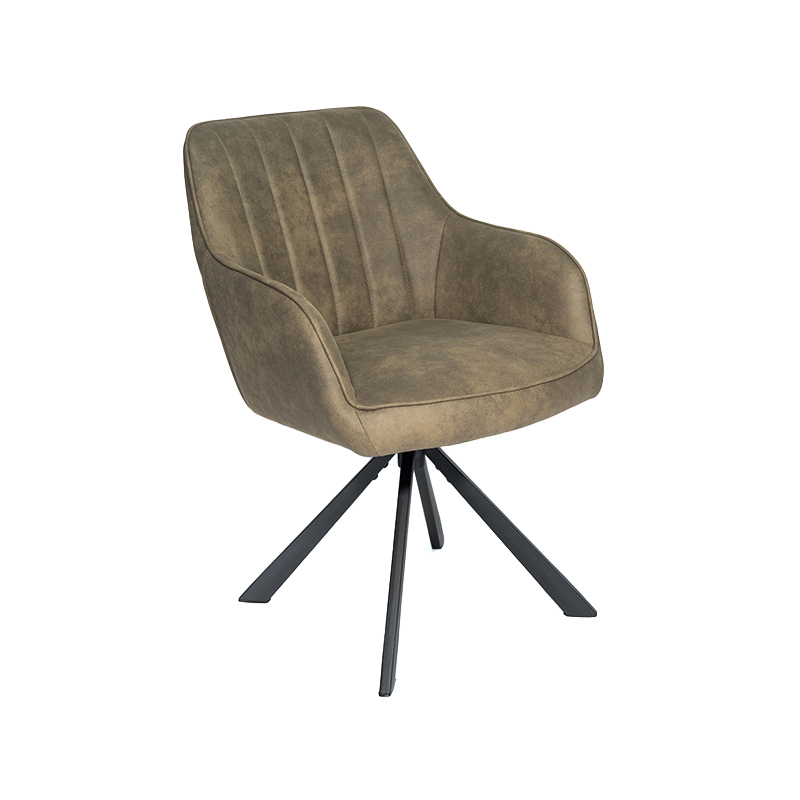
Steel-framed chairs use cold-rolled or pre-coated steel tubes that are bent into side rails and welded at the joints. Good factories grind the weld smooth so that it does not puncture fabric or create a stress point. For a 360-degree swivel dining chair with a steel frame, the base plate is welded or bolted to the underside of the frame, and the thickness of that plate determines how much weight the swivel mechanism can carry over time. Powder coating protects the steel, but the hidden factor is weld penetration; a thin weld looks acceptable until the chair is loaded.
 Wholesale 360° Swivel Fabric Dining Chair With Steel Frame & Padded Upholstery SAnji Beifeite Furniture Co., Ltd Is China Wholesale 360° Swivel Fabric Dining Chair With Steel Frame & Padded Upholstery Suppliers, Compa...View Product →
Once the frame passes inspection, the seat cushion takes over. Comfort is mostly a conversation about foam density and support, not thickness alone. Most fabric dining chairs use polyurethane foam with a density somewhere between 20 and 35 kg/m³. Lower-density foam is cheap and feels soft in the showroom, but it compresses permanently under daily use and produces the “bottoming out” effect after a season of weight. High-density foam costs more and feels firmer initially, yet it keeps its shape far longer.
Many factories now use a double-layer construction: a firm base layer carries the load while a softer top layer adds initial cushioning. Beneath the foam, either elastic webbing or serpentine springs stretch across the seat box. The tension of that support layer decides how deep the seat feels. If it is too loose, even a high-density foam block will deflect all the way to the frame when someone sits down. Adding a layer of polyester fiber between foam and fabric is common; it softens the surface feel and keeps the fabric from rubbing against the sharper edges of the foam block. That extra attention is noticeable in chairs like the easy-to-clean, stain-resistant high-back dining chair, where the combination of fiber fill and a structured back panel prevents wrinkles while still allowing the cover to be removed and wiped down.
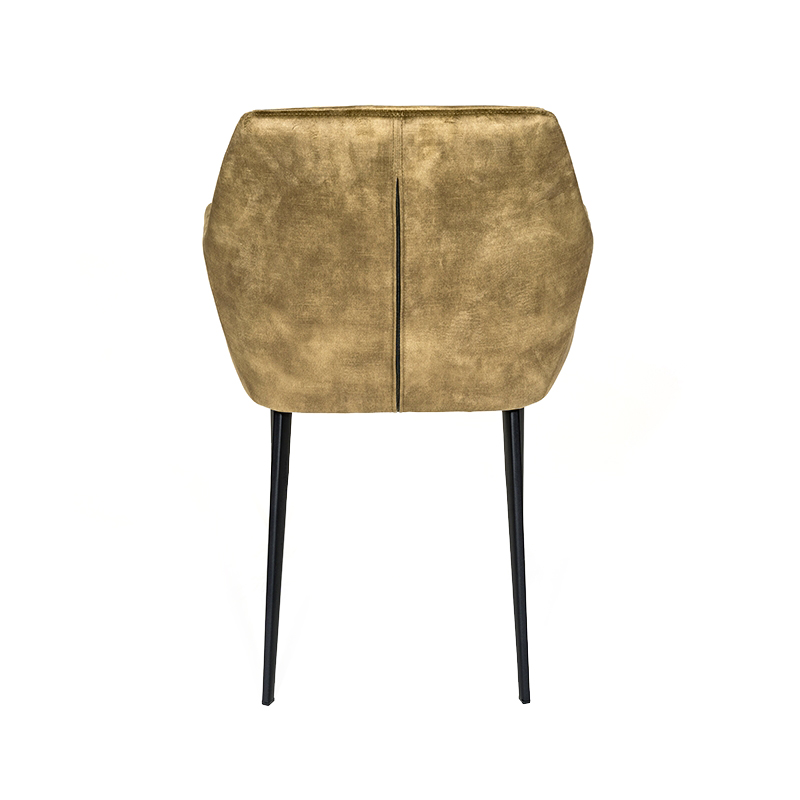 Wholesale Easy to clean, stain resistant, high back dining chair Suppliers, CompAnji Beifeite Furniture Co., Ltd Is China Wholesale Easy to clean, stain resistant, high back dining chair Suppliers, Company And Easy to...View Product →
Before upholstery, the fabric must become an exact-fitting cover. Cutting starts with inspection of the roll for shading, flaws, and directional loops that can change the look of the final cover. When a pattern has a repeat, the cutting layer is arranged so that the pattern on the back and the seat line up; otherwise, the pieces may look mismatched even though they were cut from the same roll. Layout efficiency also matters because fabric utilization directly affects the unit price, which is why factories try to nest the pieces as tightly as possible.
The sewing department converts those cut pieces into the finished cover. Straight seams are done on industrial lockstitch machines, while curved corners require walking-foot or double-needle machines. For removable covers, a zipper is inserted at the back edge or bottom, and the cover is fitted over the foam block after assembly; for fixed upholstery, lining and piping are sewn in before the cover is pulled onto the frame. Stitch tension must be balanced. Too much tension and the seam puckers; too little and the seam will open when it is stretched over the frame.
Upholstery is often the most hands-on step. The operator pulls the cover over the foam and frame, adjusting fabric tension constantly so that it sits smoothly around the corners and along the back edge. On fixed covers, the fabric is folded over the seat panel and secured with pneumatic staple guns. Staple length and spacing matter: too short and the fabric tears away in use; too close to the edge and the wood splits. On removable covers, the cover is dressed over the foam, and zippers or hook-and-loop fasteners do the final tensioning.
During hand wrapping, the operator may insert padding strips or cardboard along sharp inner edges so that the fabric does not wear against the metal or wood. Those invisible strips prevent the most common complaint after months of use: a raised line that begins cutting into the fabric from inside. Even a simple chair style benefits from those protective strips, and the difference becomes obvious when you press the sides of two samples side by side.
After upholstery, the chair goes to final assembly, where the back, seat unit, armrests, and rotating mechanism are joined. This step looks simple, but a lot of defects come from here. Bolts that connect the swivel plate to the seat box must be tightened to the specified torque. Under-tightening leads to a chair that wobbles or clicks during rotation; over-tightening can crack or compress the seat panel. On a steel-framed upholstered swivel dining chair, the bearing under the seat is tested by spinning the chair several times, checking for grinding or excessive play.
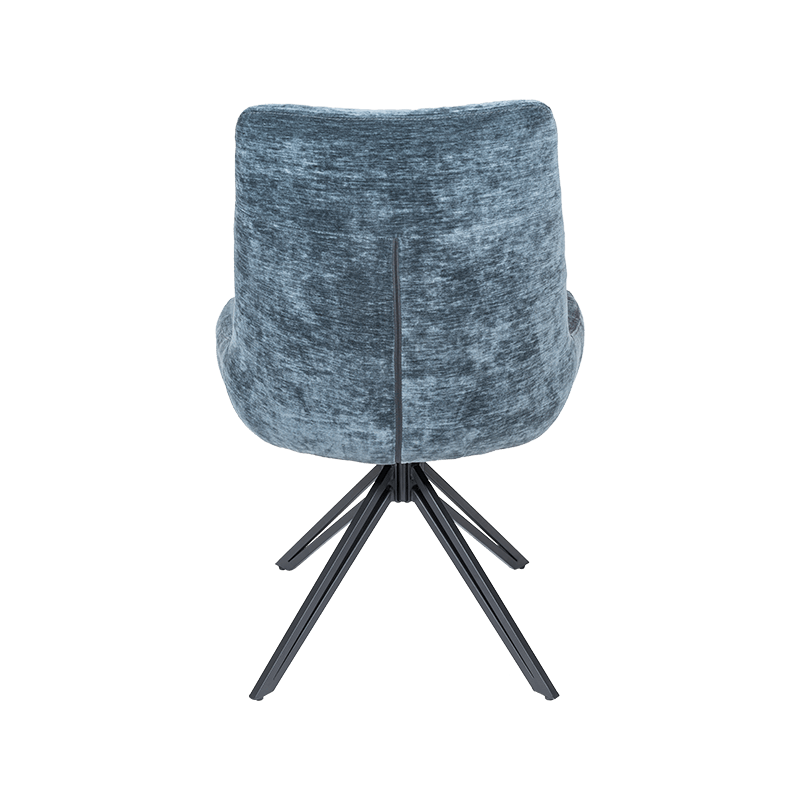 Wholesale navy blue velvet dining room chairs, Four Metal Legs Steel Frame UpholAnji Beifeite Furniture Co., Ltd Is China Wholesale navy blue velvet dining room chairs, Four Metal Legs Steel Frame Upholstered Armless ...View Product →
When chairs are shipped in flat-pack form, the assembly instruction, hardware pack, and pre-drilled holes must match production. A common inspection mistake is to assume that all product in a container will be delivered fully assembled. If the contract calls for KD (knock-down) packaging, the quality check has to include the physical fit of legs, screws, and seat tops; otherwise customers end up with missing parts and a negative first impression.
During production, inspection appears at three levels: in-process, final, and pre-shipment. In-process checks cover frame dimensions, stitch quality, and fabric cleanliness after upholstery. Final inspection tests the finished chair for stability, swivel movement, and visual flaws. Pre-shipment inspection applies the AQL sampling plan, usually the same standard that a buyer would use in their own warehouse. The most common failure areas are not the fabric itself but the frame under lateral load and the fixings holding the seat. A dining chair that stands well under a single vertical load can still collapse when someone leans back at an angle. That is why many buyers request metal chair leg load testing or BIFMA-style procedures before accepting mass production.
The table below lists typical inspection points seen in dining chair production. It is a reference, not an industry rule; final standards should come from the written agreement between buyer and supplier.
| Stage | What is checked | Typical acceptance point |
|---|---|---|
| Incoming materials | Fabric flaws, density of foam | No visible shading or defects; density matches spec |
| Frame | Wood moisture / weld appearance | Secure joints, smooth surfaces |
| Sewing | Skipped stitches, zipper function | No open seams; zipper slides cleanly |
| Upholstery | Wrinkles, edge position, staple fastening | Flat covering, no odd pull; no visible folds |
| Assembly | Torque on bolts, swivel function | No rocking; smooth rotation |
| Final inspection | Visual defects, packaging | No transit damage; AQL sample compliant |
For buyers who are not placing a simple catalog order but developing their own chair, the manufacturing sequence is a map of what is easy or difficult to change. Swapping the cover fabric or the foam density is simple, because it only affects the sewing and upholstery stages. Changing the seat depth, on the other hand, changes the foam-cutting pattern, the frame dimensions, the webbing length, and the sewing template. A supplier that treats these knock-on effects as part of the plan makes the whole development process faster.
That is why we talk about design customization as something that should be synchronized with shop-floor capabilities, not just with sketches. When a factory has control over frame cutting, welding, cushioning, and upholstery under one roof, it can adapt a design quickly without creating a new product from scratch. Knowing how the chair is made also tells you which tests to run on which prototype, saving time and money before final approval.
Back to that chair in your hands. Its weight, stability, and fabric tension are all checkable outcomes of the production process. If the frame is stable, the foam keeps its shape, and the cover is pulled tight without wrinkles, the chair is likely to survive real use. If you are buying through a vendor, those are the physical signs to evaluate side by side before ordering. When you work with a factory directly, you can go one step further and compare manufacturing capabilities, real test data, and factory walkthrough reports before committing to a production run.
There is no mystery behind a well-made fabric dining chair. There is only the frame, the foam, the seam, and the staple — and whether each one was assembled with the right material and the right attention. That knowledge turns the buying process from a photo-based guess into a measurable decision.

Products
Contact info.
No 1255, Xingye Road, Tianzihu Modern Industrial Park, Anji County, Zhejiang Province, China
+86-13587919519
sales@bftfurniture.com
