
 English
 русский
 Español
 عربى
عربى

No 1255, Xingye Road, Tianzihu Modern Industrial Park, Anji County, Zhejiang Province, China
Content
Imagine approving a fabric dining chair sample, signing off on a container, and then receiving the first wave of complaints four months later: loose seat foam, frayed seams, a wobbly backrest. The sample looked right. The price was right. But the quality standards were never verified, and the cost of that omission lands squarely on the buyer. This scenario plays out across the furniture trade every year, and it is entirely preventable when you evaluate suppliers with objective performance criteria.
Quality standards in fabric dining chair manufacturing extend far beyond appearance. They define how much weight the frame can carry, how many abrasion cycles the fabric can survive, how dense the seat foam must be, and how consistently a factory reproduces those properties across thousands of units. This article explains the specific standards, test methods, and inspection checkpoints that matter when sourcing fabric dining chairs, plus the questions to ask before you commit to a bulk order.
Fabric dining chairs face some of the most demanding use patterns in both household and commercial furniture. They are sat on multiple times a day, pulled in and out, leaned back, and regularly exposed to spills, food residue, and cleaning chemicals. In restaurants and hotel dining areas, the abuse multiplies. A chair that only meets visual expectations will fail quickly; one that is built and tested to recognized standards can serve for a decade or more. The conclusion is straightforward: standards exist because ordinary use destroys chairs that were never engineered to withstand it.
Standards also deliver practical benefits to buyers. They prevent defects by exposing weak points before thousands of units are produced. They create an objective basis for comparing suppliers, so price is not the only variable in the decision. They provide legal protection when a batch fails, because the specification was documented in advance. And they protect your reputation by reducing returns, warranty claims, and negative reviews. If a manufacturer cannot name a standard or produce a test report, the safest interpretation is that its quality claims are unverified.
The frame is the skeleton of a fabric dining chair, and it is where the most significant hidden quality differences live. Two frameworks dominate international procurement: BIFMA X5.4, the U.S. standard for lounge and dining seating, and the EN 12520/EN 12521 series, which governs domestic and non-domestic seating in Europe. Neither is a single test. Each specifies load limits, stability checks, fatigue cycling, and joint integrity under real-world conditions.
A typical structural evaluation sequence includes a vertical static load test, in which the seat carries a set weight for a defined period; a forward and backward stability test, in which the chair must not tip under weighted edge loads; a cyclic fatigue test, in which the seat and backrest survive tens of thousands of repeated loading cycles; and a drop or impact test for frames exposed to rough handling. Commercial duty classifications push these thresholds well above residential levels, reflecting the heavier and more frequent use chairs receive in restaurants, cafés, and hotel dining rooms.
| Property | Residential Minimum | Commercial/Contract Minimum |
|---|---|---|
| Vertical seat static load | 160 kg | 220 kg |
| Fabric abrasion (Wyzenbeek) | 15,000 double rubs | 30,000 double rubs |
| Seat foam density | 25–30 kg/m³ | 35 kg/m³ and above |
| Seat and backrest fatigue cycles | Tens of thousands | 100,000+ cycles |
Frame material determines how well a chair handles these loads. Solid hardwood and welded steel are the two dependable options; low-density particleboard and thin-walled tubing are not. Steel frames are especially effective for dining chairs with swivel mechanisms or metal legs, because the welded joints transmit load predictably and resist the lateral stresses that cause glued wooden joints to fail. The finish matters as well. A quality powder-coated or electroplated surface resists rust and survives the regular wipe-downs that dining environments require, and buyers should ask whether metal parts have passed salt-spray or humidity testing before approving a model.
A practical example is the steel-framed upholstered swivel dining chair, where the welded steel substructure carries the repetitive loads while the padded upholstery provides comfort. The frame is the component that determines service life, and it is exactly the component a visual inspection cannot confirm.
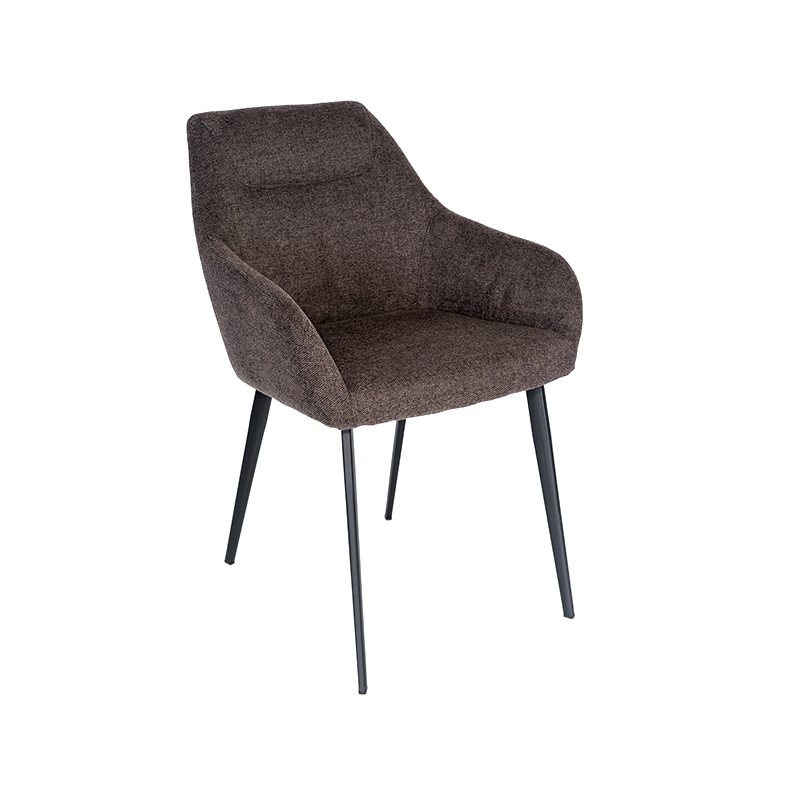
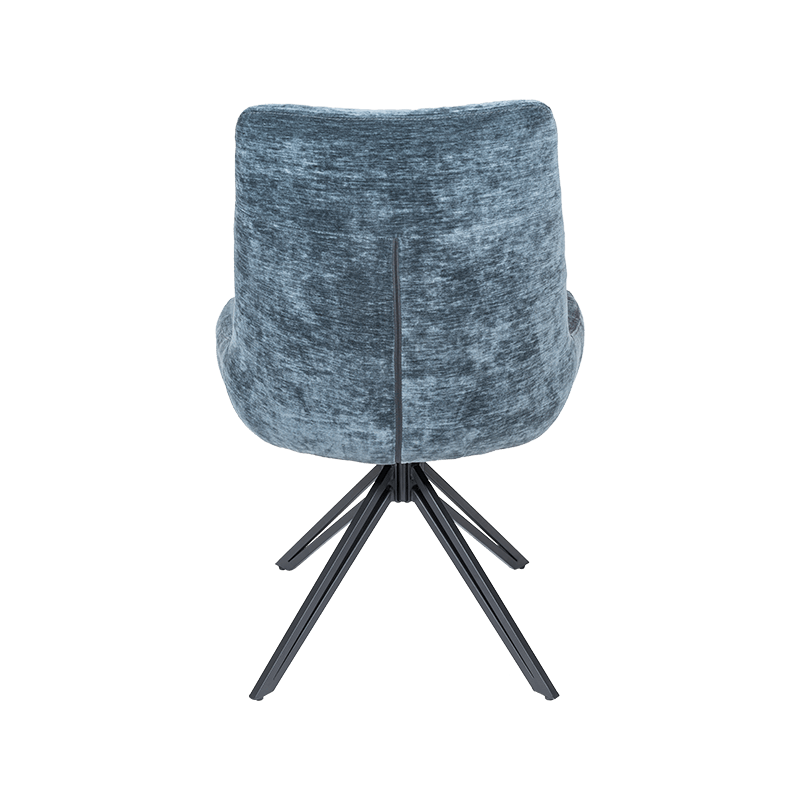 Wholesale navy blue velvet dining room chairs, Four Metal Legs Steel Frame UpholAnji Beifeite Furniture Co., Ltd Is China Wholesale navy blue velvet dining room chairs, Four Metal Legs Steel Frame Upholstered Armless ...View Product →
Fabric is the most visible component of a fabric dining chair, and it is also where quality claims are most often exaggerated. A textile that looks durable in a showroom can fail within months in a real dining room. Three properties define fabric performance: abrasion resistance, cleaning classification, and colorfastness.
Abrasion resistance is measured using two dominant methods. The Wyzenbeek test (ASTM D4157) rubs a piece of cotton duck fabric across the upholstery in both directions until yarns break, reporting the result in double rubs. The Martindale test (ISO 12947), more common in Europe, uses a wool abradant moving in a Lissajous pattern and reports the result in rubs. For dining chairs, 15,000 Wyzenbeek double rubs is the accepted residential minimum, while commercial dining environments should use fabrics rated at 30,000 double rubs or higher. On the Martindale scale, 20,000 to 40,000 rubs is the working range for demanding upholstery applications.
Every upholstery fabric carries a cleaning code that states which cleaning agents are safe. W permits water-based cleaners only, S permits solvent-based cleaners only, WS allows both, and X means vacuuming only. For a dining chair that will encounter food, drink, and regular wiping, WS-rated fabric is the practical minimum. A stain-resistant treatment adds another layer of defense by keeping liquids on the surface long enough to be wiped away before they penetrate the yarn.
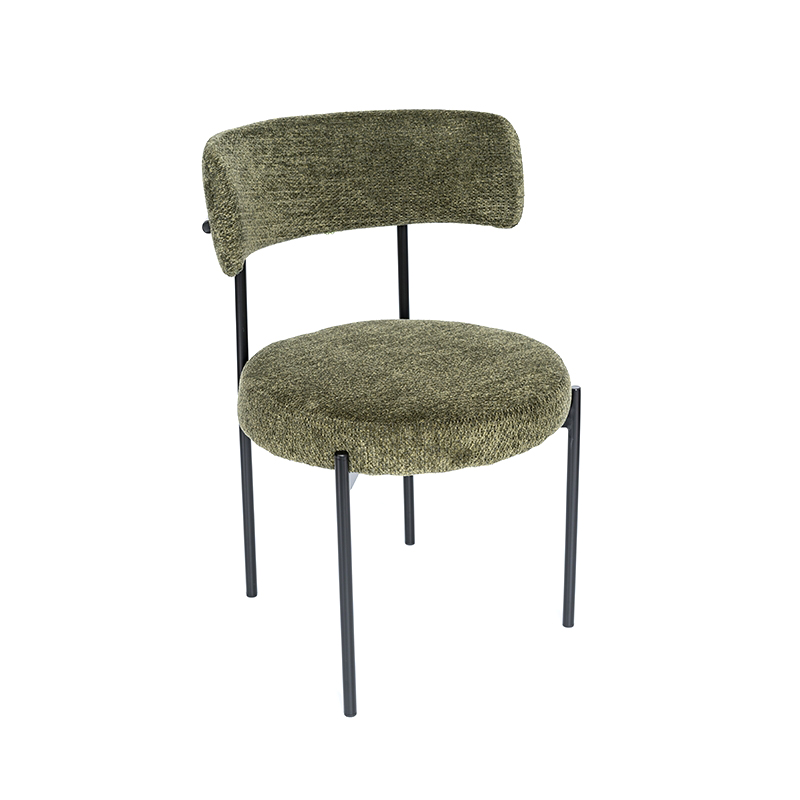
The easy-to-clean, stain-resistant high-back dining chair is built around exactly these requirements. Its fabric is selected for stain resistance and wipe-down maintenance, which directly affects how presentable the chair remains after years of daily use in a family kitchen or a busy restaurant.
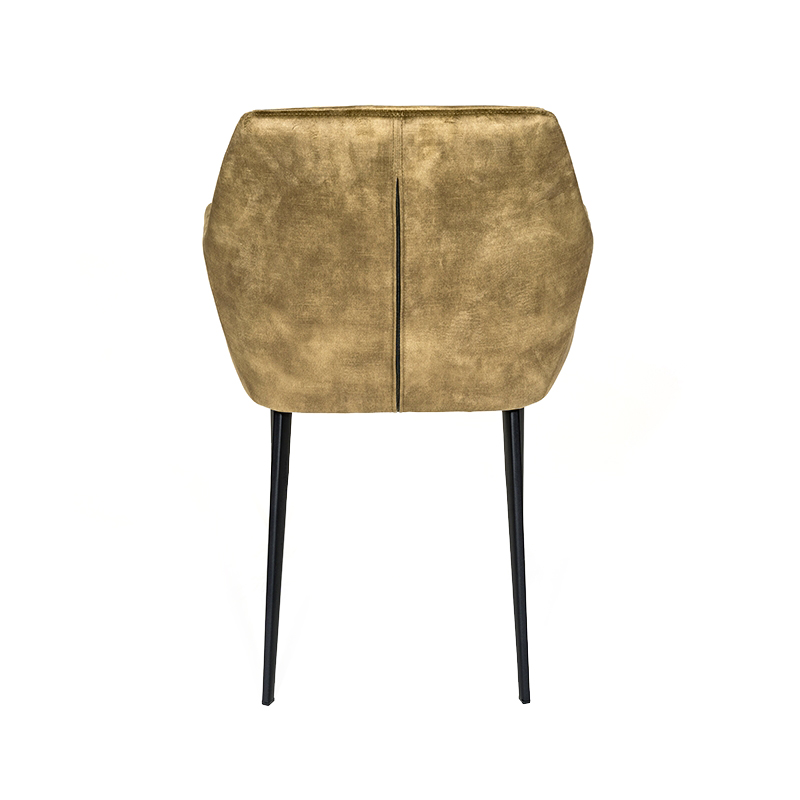 Wholesale Easy to clean, stain resistant, high back dining chair Suppliers, CompAnji Beifeite Furniture Co., Ltd Is China Wholesale Easy to clean, stain resistant, high back dining chair Suppliers, Company And Easy to...View Product →
The third metric is colorfastness. Fabrics that fade under sunlight or bleed during cleaning are silent quality failures that surface months after delivery. Buyers should request colorfastness-to-light test results (AATCC 16 or ISO 105-B02) and crocking tests (AATCC 8) for dark or saturated colors. These reports are inexpensive for a manufacturer to produce, so a supplier that cannot provide them is an immediate red flag. The practical relationship between abrasion values, stain resistance, and cleaning codes is covered in more depth in our article on commercial upholstery standards and how to interpret fabric test data.
Frame and fabric are the components buyers talk about; foam is the one they forget. Yet foam quality determines whether a chair still feels comfortable after its first year, and it is a common cause of premature failure. The single most reliable indicator is foam density, measured in kilograms per cubic meter. Lightweight foam around 20 kg/m³ is inexpensive and feels soft at first, but it loses shape within months under daily sitting. Foam at 25–30 kg/m³ is the practical minimum for residential dining chairs. For commercial dining and heavy daily use, 35 kg/m³ or higher is the range that keeps seat support stable over time.
Firmness is measured separately as indentation load deflection, or ILD. Low ILD foam is plush but compresses permanently; dining chairs need a medium to medium-high ILD so the seat remains supportive without feeling hard. High-resilience foam, which recovers its shape after repeated compression, is the preferred material because it resists the bottoming-out effect that destroys cheaper cushions.
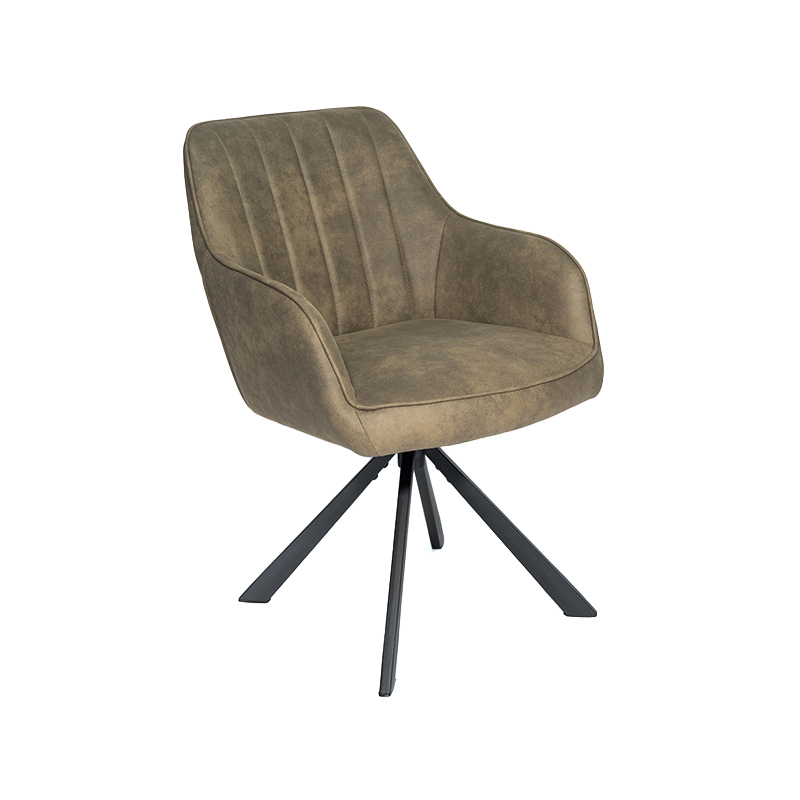
The 360-swivel dining chair with steel frame and padded upholstery pairs a denser seat pad with a steel substructure for a specific reason: swivel motion adds lateral stress to the cushion, and low-grade foam breaks down noticeably within months under that kind of load. Pad density is part of the specification, not an afterthought.
 Wholesale 360° Swivel Fabric Dining Chair With Steel Frame & Padded Upholstery SAnji Beifeite Furniture Co., Ltd Is China Wholesale 360° Swivel Fabric Dining Chair With Steel Frame & Padded Upholstery Suppliers, Compa...View Product →
Standards on paper are meaningless if a factory cannot reproduce them across a full production run. The difference between a mature manufacturer and an assembly workshop is the quality control discipline applied between raw material intake and the packed carton. In fabric dining chair production, the critical checkpoints are:
Batch consistency is the reason buyers should audit factories rather than simply inspect samples. When evaluating a supplier, ask to see inspection records and defect rates, not just a polished showroom. Our manufacturing facility operates with these checkpoints integrated into the production flow, and inspection data is logged at each stage so quality remains traceable rather than improvised.
Before committing to a volume order, request written answers to the following questions. The responses separate manufacturers that work to standards from those that work to impressions.
Suppliers that answer with data, documentation, and defined processes are a genuine asset. Customization should never be a reason to relax standards; a responsible ODM/OEM partner applies the same testing discipline to modified models as it does to its standard catalog. That principle is the basis of our design and custom program, where every tailored model still passes frame testing, fabric verification, and assembly inspection before it is released for production.
Quality standards in fabric dining chair manufacturing are not bureaucratic paperwork. They are the measurable difference between a chair that lasts for years and one that fails within months. Verify the structural standard, request the fabric test report, confirm the foam density, audit the production checkpoints, and document every claim in writing. The sample that impressed you in the showroom only matters if the factory can reproduce it a thousand times. Buy the data along with the design, and your sourcing process becomes far more predictable.

Products
Contact info.
No 1255, Xingye Road, Tianzihu Modern Industrial Park, Anji County, Zhejiang Province, China
+86-13587919519
sales@bftfurniture.com
