
 English
 русский
 Español
 عربى

No 1255, Xingye Road, Tianzihu Modern Industrial Park, Anji County, Zhejiang Province, China
Content
A restaurant operator once told us why they switched dining chair suppliers. The first batch looked excellent in the showroom, but after eight months the seats had flattened, the seams had started to fray, and two frames wobbled badly. The problem was not the fabric alone. It was the combination of fabric, frame, foam, and finishing details that had never been specified properly in the first place.
The conclusion is straightforward: fabric dining chair quality is decided by four interacting factors — fabric performance, frame construction, cushioning density, and finishing details. Get all four right, and a chair survives daily use in a family kitchen or a busy restaurant. Miss one, and the entire chair feels like a compromise within a year.
The upholstery is the first thing a buyer touches, but its real quality is invisible in a showroom photo. It shows up in test results and in how the fabric behaves after hundreds of meals.
The most widely used measure of abrasion resistance is the Martindale rub test. Light domestic use starts around 20,000 rubs; a dining chair used daily in a restaurant, café, or open-plan office should start at 30,000 rubs, and high-performance contract fabrics reach 50,000 to 100,000 cycles. Ask the manufacturer for the Martindale result on the exact fabric being quoted, and confirm the underlying test standard as well. Our overview of commercial upholstery testing standards explains how rub count, stain testing, and colour fastness work together in practice.
Dining chairs absorb whatever gets spilled on them. Tight-weave polyester, microfibre, and treated performance fabrics resist liquids far better than loosely woven natural fibres, which is why stain-resistant, high-back dining chairs with treated upholstery are a common choice for commercial and family settings. A water-repellent finish makes a spilled drink bead on the surface instead of soaking into the cushion, and it allows repeated spot cleaning without fading or stiffening. For households with children or pets, this one factor usually outweighs every other fabric characteristic.
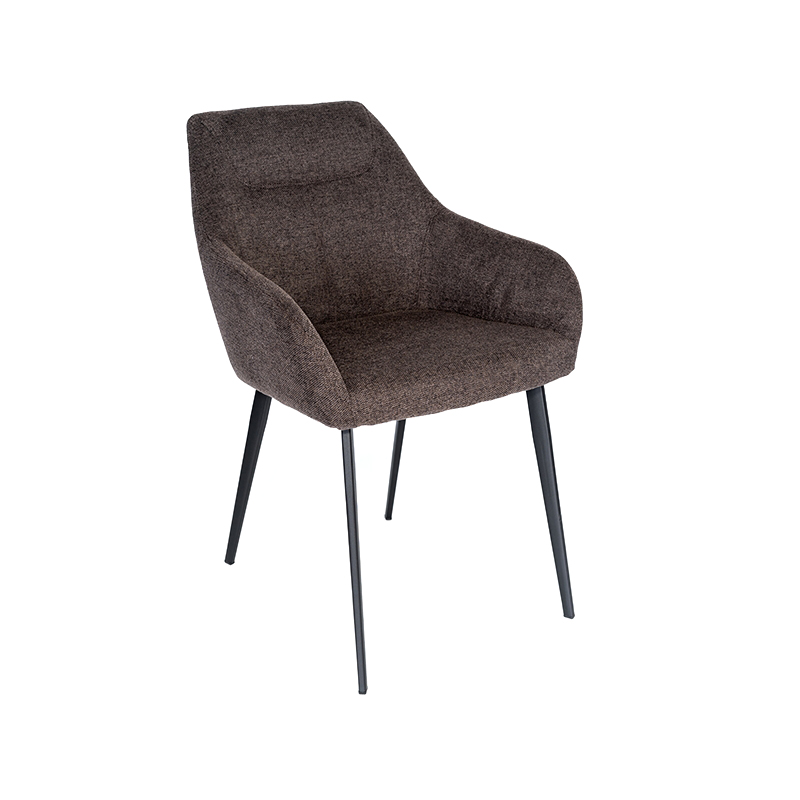
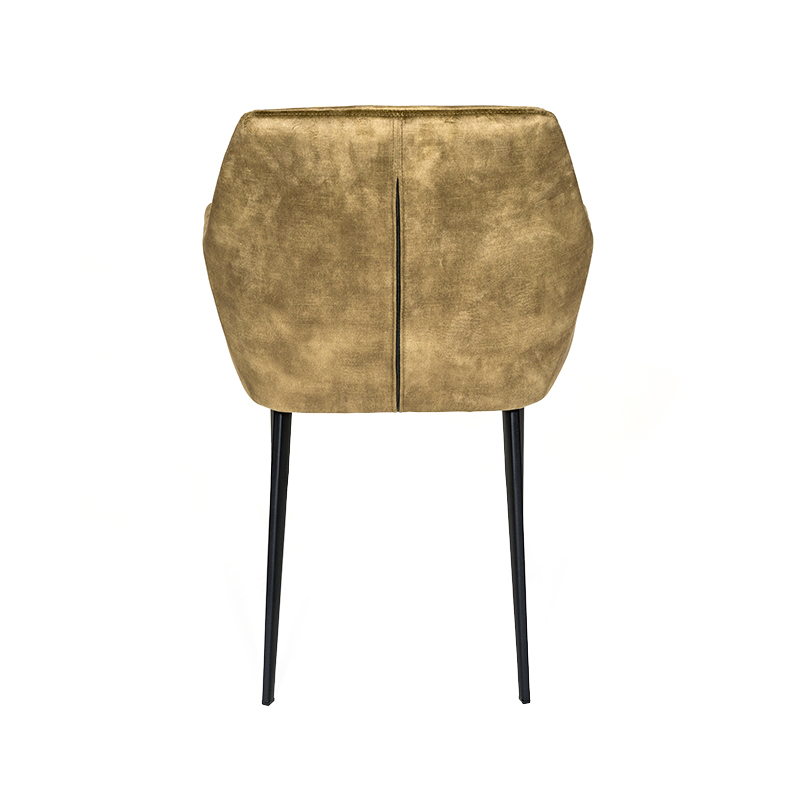 Wholesale Easy to clean, stain resistant, high back dining chair Suppliers, CompAnji Beifeite Furniture Co., Ltd Is China Wholesale Easy to clean, stain resistant, high back dining chair Suppliers, Company And Easy to...View Product →
Sunlight breaks down dye molecules gradually. A chair sitting near a dining-room window can fade noticeably within a single year if the fabric has weak lightfastness. Look for a lightfastness rating of at least 4 on the blue wool scale, and remember that solution-dyed synthetic fibres hold their colour far longer than piece-dyed fabrics.
Fabric can be replaced; the frame has to last the life span of the chair. This is where low-cost production reveals itself first.
Durable dining chairs use either kiln-dried hardwood or welded steel tube. Steel frames should have clean, continuous welds at every joint — no pitting, no gaps — and the tube wall thickness has to match the chair's size and function. A thin frame flexes on hard floors, loosens at the joints, and eventually transfers every shock directly to the structure. Chairs with moving parts need even more attention: our 360-degree swivel dining chair with a steel frame and padded upholstery uses welded steel specifically because it handles the twisting forces that swivel mechanisms create. The weight of the chair is also a useful clue — a heavier chair generally means more substantial material somewhere, while a suspiciously light chair usually means something was thinned out.
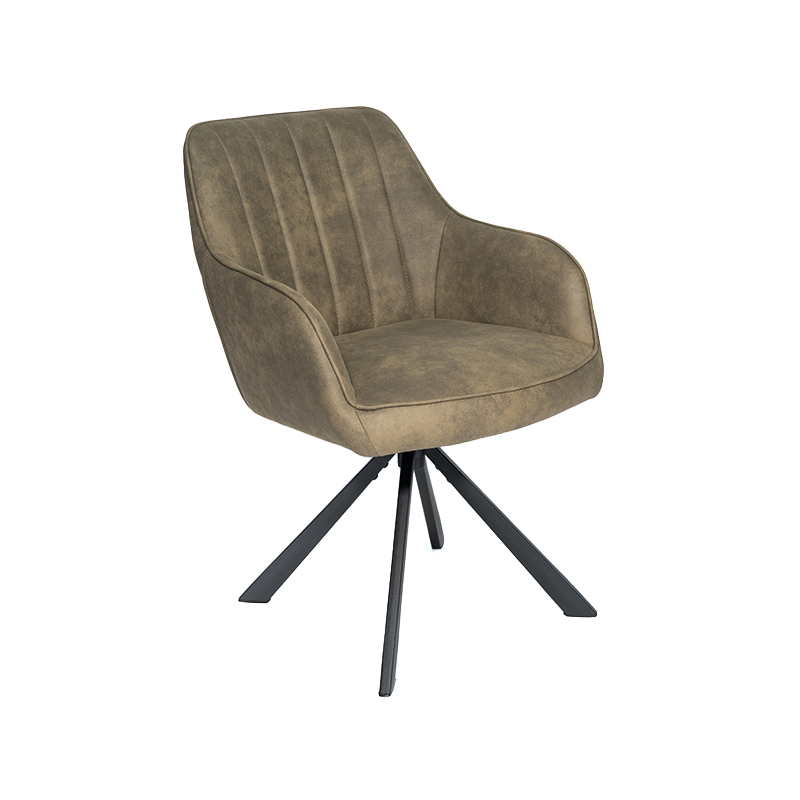
 Wholesale 360° Swivel Fabric Dining Chair With Steel Frame & Padded Upholstery SAnji Beifeite Furniture Co., Ltd Is China Wholesale 360° Swivel Fabric Dining Chair With Steel Frame & Padded Upholstery Suppliers, Compa...View Product →
A frame can look solid in a photograph and still fail at the joints. That is why structural standards exist. BIFMA and equivalent international standards specify vertical load tests, side-thrust tests, and impact tests that simulate years of sitting, leaning, and guests shifting their weight. Compare suppliers on which structural tests their actual model has passed, not on generic marketing claims. Load testing requirements for upholstered dining chairs give you a practical baseline for what these tests should cover.
Every fabric dining chair feels comfortable in the first week. The quality difference appears at month nine, when low-density foam has already started to compress permanently.
High-density polyurethane foam in the 25 to 35 kg/m³ range recovers its shape after compression, while low-density foam gradually collapses under the same weight. Commercial contract seating typically specifies higher densities for exactly this reason. Ask for the foam density in the specification sheet instead of judging the cushion by how soft it feels in the showroom — softness depends on the foam's formulation, while density determines its service life.
The foam sits on a support base, and that base does more work than most buyers realise. Moulded plywood platforms or properly tensioned webbing distribute weight evenly; a weak base lets the foam sag between support points, accelerating tearing and edge breakdown. When the chair includes a swivel or reclining mechanism, the connection between the seat platform and the mechanism needs reinforcement — a steelframed upholstered swivel dining chair is built this way so the seat stays stable through thousands of rotations.
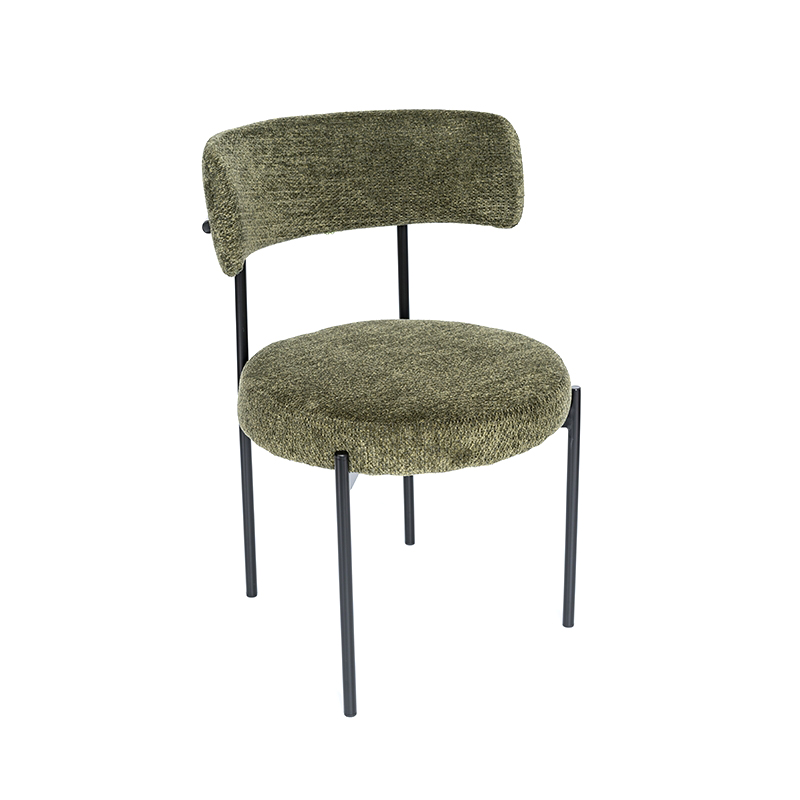
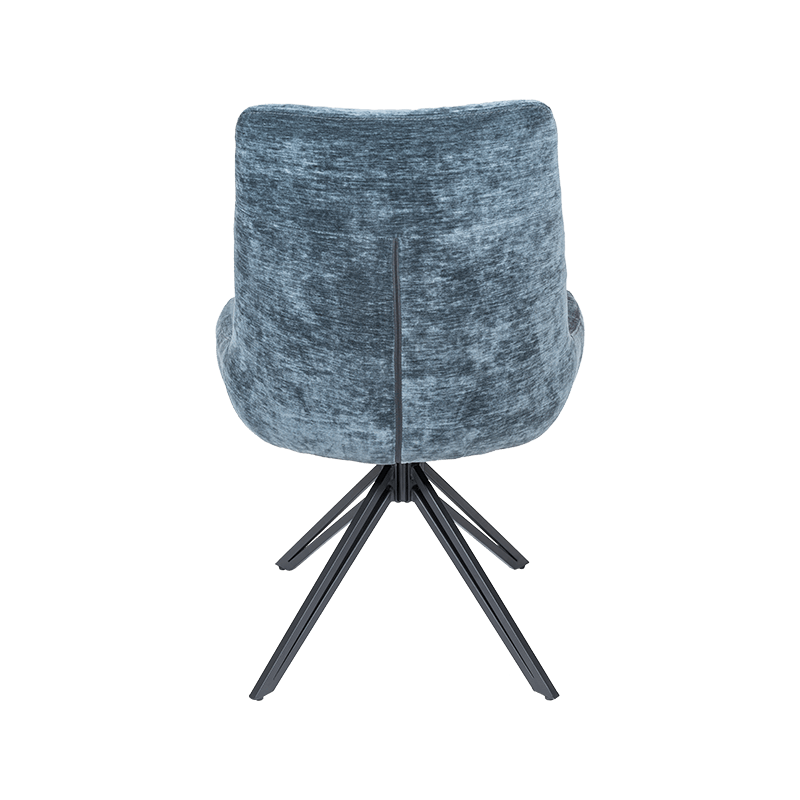 Wholesale navy blue velvet dining room chairs, Four Metal Legs Steel Frame UpholAnji Beifeite Furniture Co., Ltd Is China Wholesale navy blue velvet dining room chairs, Four Metal Legs Steel Frame Upholstered Armless ...View Product →
An experienced inspector can judge a fabric dining chair's quality in three minutes by examining the details most buyers never think to check.
Straight, consistent stitching with a dense stitch count — typically 8 to 10 stitches per inch — keeps upholstery firmly in place, while loose or uneven stitches become seam failures under tension. Double-stitched seams and bonded polyester thread resist the repeated pulling that happens every time somebody sits down, and reinforced corners prevent the fabric from pulling away from the frame.
Neatly aligned piping and tightly fitted fabric corners show that the upholsterer controlled the material instead of fighting it. If the chair has a swivel base, the mechanism needs a rated cycle life: 50,000 cycles or more is the sensible benchmark for daily commercial use, while the 10,000-cycle parts found in promotional furniture are not built for that workload.
None of these factors can be seen in a single product photo. They have to be confirmed through specifications, samples, and production planning.
The pre-production sample proves the design; the specification sheet proves the quality. Confirm these items in writing before production starts:
Bulk production can drift away from an approved sample. Set inspection checkpoints at fabric cutting, frame welding, and final assembly, and agree on pass/fail criteria in advance. A manufacturer with documented quality checks, such as our manufacturing facility, should be able to show you how it keeps batch quality consistent across large orders.
| Quality Factor | What to Verify | Reference Threshold |
|---|---|---|
| Fabric abrasion | Martindale rub count | 30,000+ cycles for daily dining use |
| Stain resistance | Water/oil repellent finish | Beading effect on liquid spill test |
| Fade resistance | Lightfastness rating | At least 4 on the blue wool scale |
| Foam density | Polyurethane foam density | 25–35 kg/m³ for daily seating |
| Frame strength | Weld continuity and tube gauge | Full welds at all joints, no pitting |
| Swivel mechanism | Cycle life testing | 50,000+ rotation cycles |
When these numbers are documented at the start of a project, the chairs that arrive in your container will match the standard you approved. When they are not, you are buying a promise instead of a specification.

Products
Contact info.
No 1255, Xingye Road, Tianzihu Modern Industrial Park, Anji County, Zhejiang Province, China
+86-13587919519
sales@bftfurniture.com
